Researchers at Tohoku University and collaborating institutions have engineered a new class of crystalline material that simultaneously achieves high CO2 filtering speed and high accuracy. It is the breakthrough, scientists thought was physically impossible within conventional membrane technology.
Also Read: The Crucial Role of Chemical Engineering in Everyday Life
Also Read: Scientists Turn Plastic Waste and Dead Battery Acid Into H2 Fuel Using Sunlight
Understanding the Context – Problem
Every time an industry separates CO₂ from a gas mixture i.e stripping it out of natural gas before pumping it through a pipeline. To separate this mixture engineers uses a membrane where gas flows in on one side and this selective membrane decidess what gets through and what gets blocked.
For 30 years, scientists have accepted a trade-off: accurate CO₂ filters are slow, while fast ones lack precision. This limit, the Robeson upper bound, has been considered a law of nature since the 1990s. A team of scientists just broke it!
A research team has published findings in the Journal of the American Chemical Society describing a new category of engineered crystalline material that breaks this trade-off decisively, delivering both blazing CO₂ throughput and exceptional molecular discrimination simultaneously.
The Innovation Story
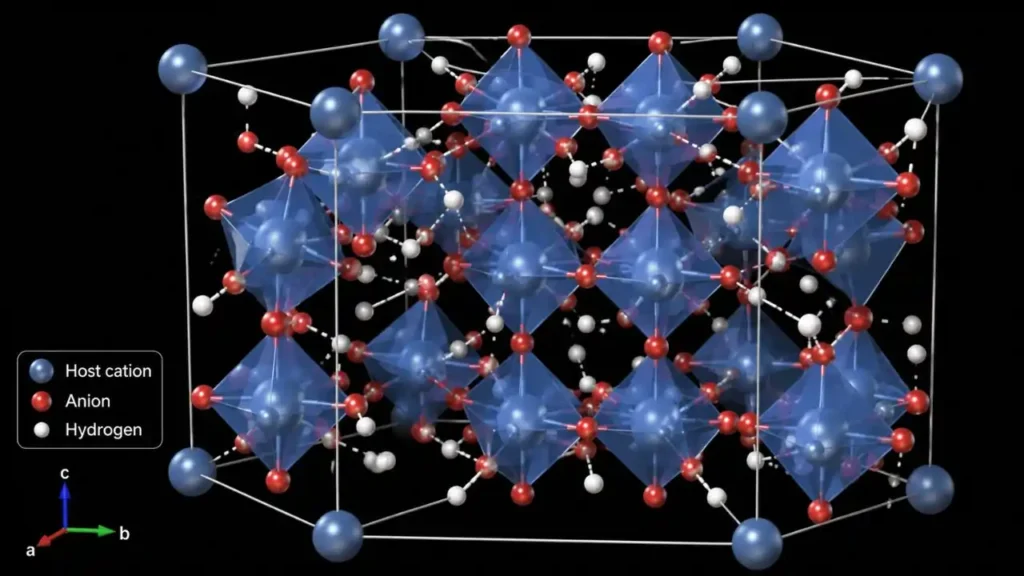
A microscopic, geometrically perfect honeycomb crystal of carbon, nitrogen, oxygen and hydrogen features repeating millions of hexagonal cells joined together by strong covalent bonds known as a Covalent Organic Framework (COF).
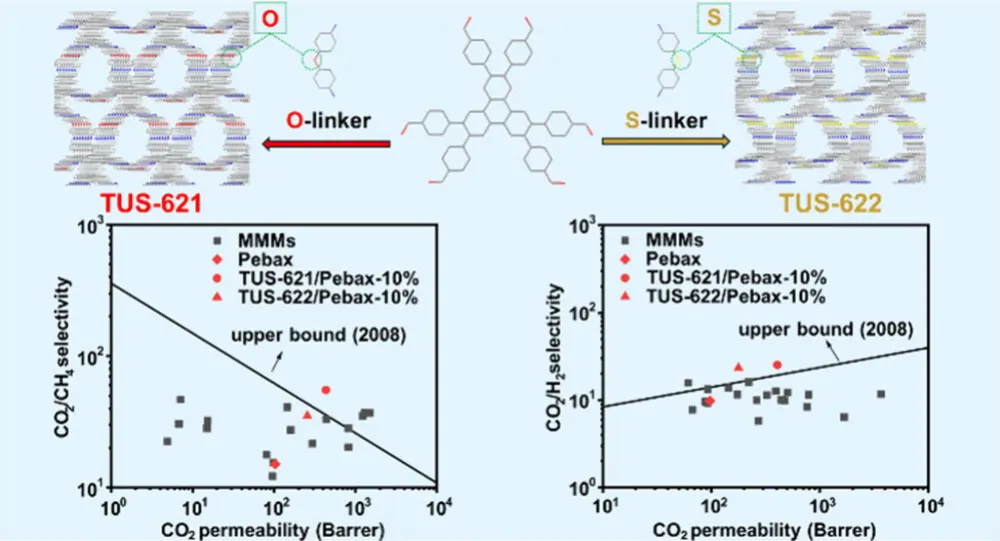
CO₂ molecules are not electrically neutral. They have a slight asymmetry in how their electric charge is distributed – scientists call this a quadrupole moment. In plain terms: CO₂ is a molecule that responds to nearby electric fields.
The team lined the inner walls of every hexagonal pore with oxygen atoms. Oxygen is highly electronegative, it pulls electrons toward itself, creating a partial negative charge on the pore walls. CO₂, because of its quadrupole nature, is attracted to these walls. It gets drawn in, moves through the crystal efficiently, and separates out the other side fast.
Methane (CH₄) does not have this electrical asymmetry. It is electrically neutral and does not interact with the oxygen-lined walls the same way. It lags. It gets filtered out.
Related: Personal Carbon Footprint Calculator – Track your CO2 Emissions
Related : Visit our thermodynamic calculator for quick calculations
Technical Explanation – Mixed Matrix Membrane & CoFs
In a Mixed Matrix Membrane (MMM), the separation of gases is governed by the solution-diffusion model. This process determines how effectively a gas permeates through the membrane based on two distinct factors:
Permeability = Solubility x Diffusivity
When COFs like TUS-621 or TUS-622 are embedded into a polymer matrix like Pebax (a copolymer made of rigid polyamide sections for structural strength and flexible polyether segments), they introduce molecularly defined, permanently porous transport domains that optimize both properties simultaneously.
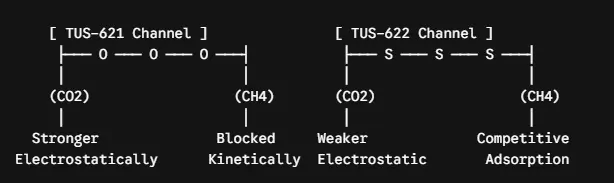
Solubility acts as a chemical gatekeeper; the bulk Pebax polymer provides an intrinsic attraction to CO2 while the embedded TUS-621 COF channels vastly amplify this effect. The pore walls of TUS-621 are engineered with highly electronegative oxygen atoms that create polar microenvironments.
Because CO2 possesses a strong quadrupole moment, it undergoes intense electrostatic attraction and electronic hybridization with these active oxygen sites, maximizing its concentration within the framework while ignoring non-polar or weakly polar gases like methane CH4 and hydrogen H2.
Diffusivity describes the physical speed and ease with which an accommodated gas molecule travels through the membrane framework. The rigid, narrow aperture of the channel allows the selected molecules to zip through line-of-sight pathways while creating a physical bottleneck for bulkier molecules..
In TUS-622, the oxygen atoms are swapped for sulfur atoms, which are bigger and “softer” in their electrical character. The effect is measurably weaker and the experiments confirmed it with striking clarity.
Related: Joule-Thomson Effect – Coefficient Calculation for CO2 and N2
Related: Fick’s second law of Diffusion Calculator
Practical & Commercial Impact
When the optimized TUS-621 COF was blended into the Pebax matrix at an optimal loading of 10% by weight, the results were definitive.
Under realistic mixed-gas operating conditions, the TUS-621/Pebax-10% membrane achieved a CO2 permeability of 433 Barrer paired with a CO2/CH4 selectivity of 55.3. This decisively shattered the 2008 Robeson upper bound performance threshold. Simultaneously, the membrane excelled at separating hydrogen, recording a CO2 permeability of 407 Barrer and a CO2/H2 selectivity of 25.2.
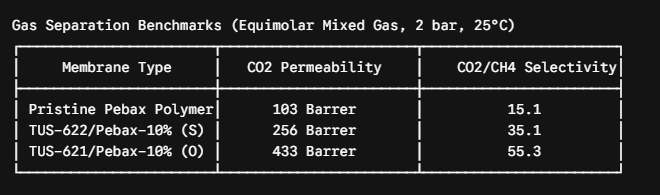
These membranes were tested continuously for 30 days without any measurable drop in performance. They held up across pressures from 2 to 10 bar and temperatures from 25°C to 100°C.
The most immediate application is natural gas purification. Today, CO₂ is stripped from natural gas using amine scrubbing – a heat-intensive chemical process. Membranes use far less energy but have always struggled with speed or accuracy. This one does not.
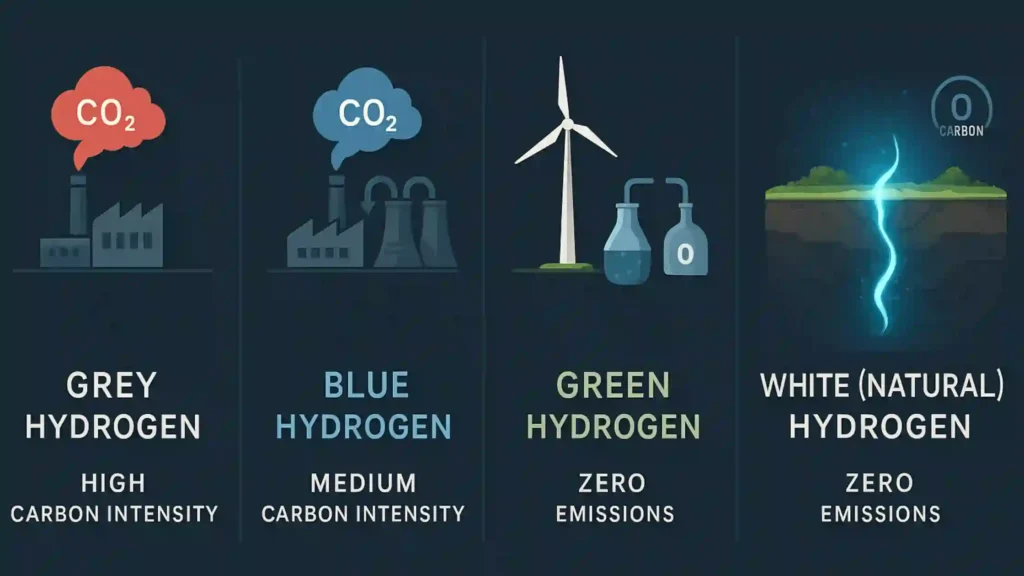
Green hydrogen is the second target. Purifying hydrogen means separating it from CO₂. The membranes are made by pouring a mixture onto a surface and letting it dry, a process already standard in industrial membrane production. Pilot-scale demonstrations could follow within five to eight years.
Primary Source Citation
Tsukasa Irie, Liting Yu, Ranjit Thapa*, Yu Zhao*, Sourav Ghosh, Mika Nozaki, Kohki Sasaki, Tokuhisa Kawawaki, Saikat Das*, Zixi Kang*, and Yuichi Negishi (2026). Heteroatom-Engineered Covalent Organic Frameworks Break the CO2 Separation Trade-Off in Mixed Matrix Membranes. Journal of the American Chemical Society. DOI: https://doi.org/10.1021/jacs.5c23169



Pingback: Breaking the Robeson Limit: A Game-Changer for Carbon Capture Membranes – Help for Wandering Minds