Every year, we produces over 400 million metric tons of plastic. Less than one-fifth gets recycled. The rest goes to landfills, poisons waterways, or gets incinerated and the carbon present inside it back into the atmosphere.
Meanwhile, the global need for clean hydrogen fuel faces a major challenge: producing green hydrogen is expensive, and making hydrogen from waste materials is even more difficult.
A team of chemists at the University of Cambridge published a study suggesting a possible solution to both problems converting plastic waste into hydrogen using sulfuric acid from discarded car batteries.
Related: Personal Carbon Footprint Calculator – Track your CO2 Emissions
Also Read: The Crucial Role of Chemical Engineering in Everyday Life
The Research
A new study published in the journal Joule on May 20, 2026, the study was led by Papa K. Kwarteng at the Yusuf Hamied Department of Chemistry, University of Cambridge.
The team demonstrated a solar-driven process called photoreforming that takes common waste plastics, dissolves them using recycled battery acid, and then uses sunlight to convert the dissolved plastic fragments into hydrogen gas and acetic acid.
Old Battery Acid + Sunlight + Plastic Waste = Clean Hydrogen Fuel.
The work represents a significant leap over prior approaches and has already attracted a patent application filed through Cambridge Enterprise.
How It Works: Photocatalyst Action
Plastic waste is made of long-chain polymers that can be broken down through a process called depolymerization, which converts them back into their original building blocks, known as monomers.
Most recycling approaches use either enzymes (biological scissors that are slow and expensive) or a strong alkaline chemicals like sodium hydroxide (which works faster but generates a lot of chemical waste and requires neutralization afterward).
This team took acid hydrolysis route using sulfuric acid recovered from spent lead-acid car batteries to break apart the plastic chains.
Once the plastic is broken down, the liquid mixture of monomers is poured into a reactor and exposed to light in the presence of photocatalyst called CoMoS₂–CNx. This material is made from carbon nitride, a low cost and scalable compound similar to graphite, combined with cobalt enhanced molybdenum disulfide nanoparticles.
Like a solar panel, the material uses light to pull electrons from plastic fragments, producing acetic acid and hydrogen gas at the same time. The reaction works at room temperature under visible light without expensive metals like platinum or palladium.
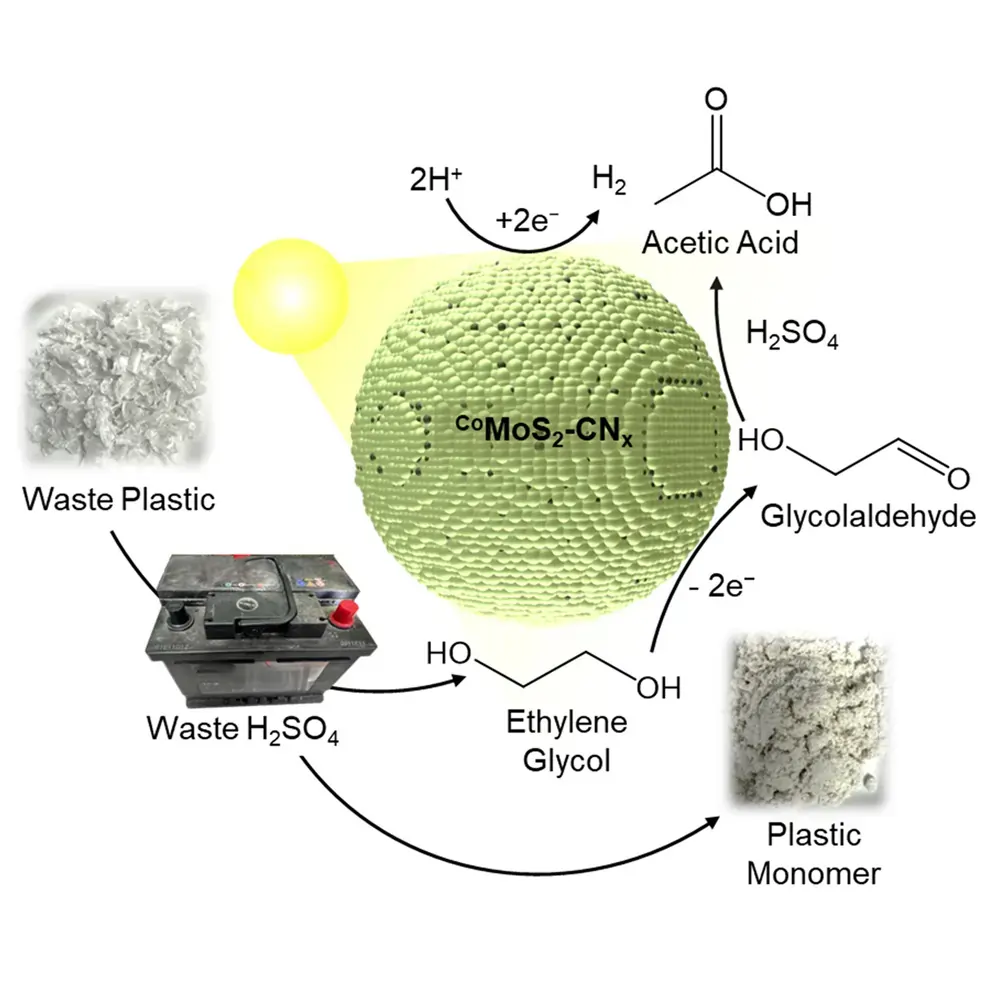
Results: This study shows under simulated sunlight, the CoMoS₂–CNx catalyst produced 0.35 mmol of hydrogen per gram of catalyst from PET plastic, increasing to 1.9 mmol under stronger 405 nm LED light. Over 24 hours, Nylon 66 and polyurethane produced 1.0 and 4.2 mmol of hydrogen per gram of catalyst, respectively.
Related : Visit our thermodynamic calculator for quick calculations
Also Read: Van der Waals Equation Calculator and PV Isotherm for Real Gases
Why Previous Photocatalysts Failed in Acid
In previous photoreforming processes, the acidic condition are effective at breaking down plastic but quickly damages most photocatalyts. When researchers used more acid resistant catalysts, the hydrogen production dropped significantly.
Chemists engineered around this by designing CoMoS₂–CNx from the ground up to be acid-stable. Molybdenum disulfide is already known for its resistance to acidic environments, and incorporating cobalt as a “promoter” tripled its hydrogen-evolution activity.
This catalyst actually improves during its first few uses – its surface restructures under acidic conditions in a way that increases its active area and boosts performance, before stabilizing over an 11-day operational test.
According to researcher, under 405 nm LED light, the system outperformed every comparable non-noble-metal photocatalyst in published literature, hitting a quantum yield of 9.0% from real PET bottle waste among the highest ever recorded for plastic photoreforming. (reference link)
The approach also worked on Nylon 66 and polyurethane, two plastics that have long resisted chemical recycling.
From Lab to Industry: The Commercial Viability
The paper documents a deliberate, three-stage scaling progression – each step designed to stress-test a different aspect of commercial readiness.
| Parameter | Stage 1 — Analytical | Stage 2 — H-cell | Stage 3 — Batch reactor | Stage 4 — Stability |
|---|---|---|---|---|
| Reactor volume | 3 mL vial | 30 mL dual-chamber | 1.7 L custom batch | 3 mL vial (repeated) |
| Catalyst used | 5 mg | 50 mg | 500 mg | 5 mg (reused) |
| PET input | 1.5 g powder | 10 g waste plastic | 3 g waste plastic | 1.5 g real bottle |
| Light source | 405 nm LED 33 mW cm⁻² | 405 nm LED array | Lepro 200W LED (~£30) | 405 nm LED 33 mW cm⁻² |
| Duration | 24 h | 24 h | 5 days | 11 days / 8 cycles |
| H₂ yield | 1.9 → 2.9 mmol gcat⁻¹ | 0.14 mmol total | 3.2 mmol · 161 mmol m⁻² | Stable across cycles |
| EG conversion | 26–40% | 43% ± 2% | 56% ± 7% | >20% across 5 cycles |
| Acetic acid selectivity | 89% | Not reported | 1.42 mmol total | H₂:AA ratio ~1:1 |
| Carbon balance | — | 72% | 74% ± 9% | >85% all cycles |
| Key finding | Chemistry established; catalyst activates on day 2 | H₂ detected in 30 min; no CO₂ byproduct | Among highest PR yields reported; no external heating | No catalyst deactivation; decline from mass loss only |
The team conducted a technoeconomic analysis comparing three operational scenarios: solar-only, LED-only, and a hybrid PV-LED system where solar panels power LEDs for 24-hour continuous operation.
| Scenario | Power source | H₂ cost (real) | H₂ cost (ideal) | 24h operations |
|---|---|---|---|---|
| Solar only | Natural sunlight (AM 1.5G) | £217.6 / kg | — | No |
| LED only | Grid electricity → 405 nm LEDs | £114.6 / kg | — | Yes |
| Hybrid PV-LED | Solar PV powers LEDs day + night | £74.8 / kg | £4.10 / kg | Yes |
Note: The UK Government’s hydrogen strategy has targeted green hydrogen below £5 per kg by 2030. The £4.10 figure, while based on idealised assumptions, suggests the process is at least in the right order of magnitude when operating parameters are optimised.
Model found that once revenues from recovered terephthalic acid, acetic acid, and formic acid are factored in, the net cost of hydrogen production turns negative i.e the system could be profitable before hydrogen sales are even counted.
Related: Why Chemical Engineers Are Switching to These Open-Source Tools in 2026
References & Disclosures
Kwarteng, P.K., Liu, Y., Han, C., Bonke, S.A., Vahey, D.M., Pulignani, C., & Reisner, E. (2026). Solar reforming of plastics using acid-catalyzed depolymerization. Joule, 10, 102347. https://doi.org/10.1016/j.joule.2026.102347
Article Link – Photoreforming of Waste Polymers for Sustainable Hydrogen Fuel and Chemicals Feedstock: Waste to Energy
Conflict of Interest / Patent Disclosure: A patent application (No. 2518549.7, filed 6 November 2025) which covers the photocatalyst and process mentioned in the research has been filed by Cambridge Enterprise, naming Papa K. Kwarteng and Erwin Reisner as co-inventors. All experimental data supporting the study’s findings are publicly available via the University of Cambridge data repository: https://doi.org/10.17863/CAM.125178.