We see everyday materials around us are invented from the batteries in our smartphones to the clean energy fuels of tomorrow, chemical engineering shapes our modern world.
But historically, inventing a new chemical process was a slow, expensive game of trial and error. Today, all of that is changing.
In this article, we look at how AI and Self-driving Labs are transforming chemical engineering in 2026. We will explore real scientific breakthroughs like AI-designed materials, and “physics-smart” computer models, digital twins etc.
Also Read : Could Natural Hydrogen (H₂) Be the Ultimate Clean Fuel of the Future?
Also Read: The Crucial Role of Chemical Engineering in Everyday Life
Introduction: AI in Chemical Engineering
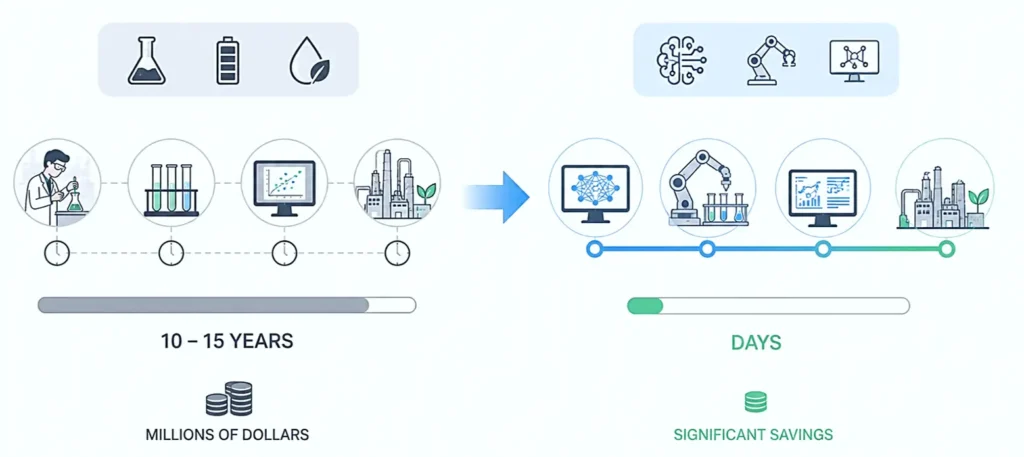
For decades, chemical engineering relied on slow trial-and-error experiments to develop new materias, battery, fuels etc. Bringing a new chemical discovery from the lab to industry often took 10 -15 years and millions of dollars.
In 2026, AI, robotic automation, and advanced computer modeling are transforming this process. AI systems can now design, run, and analyze experiments much faster than traditional methods, reducing years of research to just days.
Related: The Crucial Role of Chemical Engineering in Everyday Life
Related: 8 Python Libraries Every Chemical Engineer Should Know for Faster Workflows
Self-Driving Laboratories: Robots That Think and Do
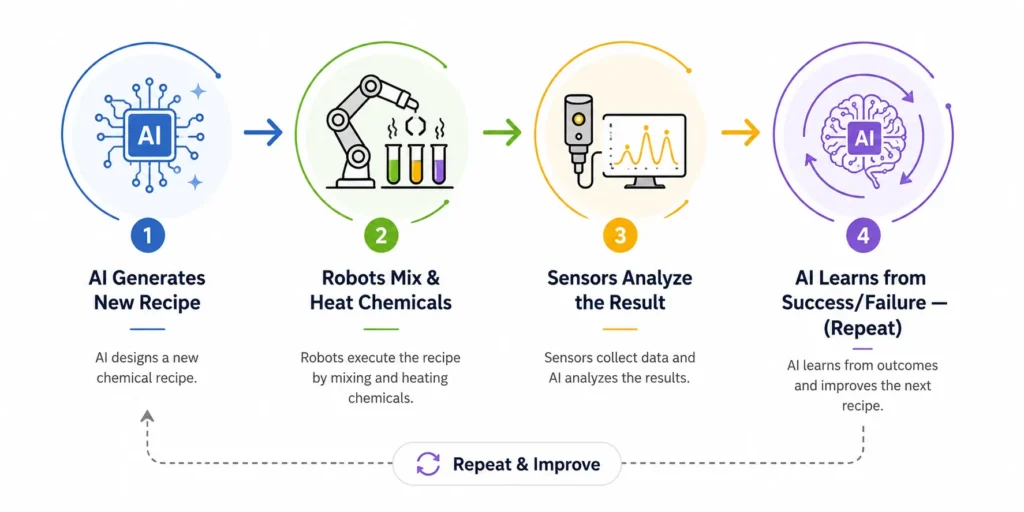
One of the most exciting breakthroughs in modern chemistry is the “self-driving laboratory.” Just like a self-driving car navigates roads without a human driver, a self-driving lab plans, executes, and analyzes chemical reactions entirely on its own.
Instead of a scientist standing at a lab bench wearing safety goggles and mixing liquids, an AI brain commands robotic arms to do the physical work.
In late 2023, two landmark papers published in the journal Nature proved that these labs were no longer science fiction. In 2026, they are becoming standard tools in major research institutions.
Coscientist: The AI Assistant That Reads the Manual
Developed by researchers at Carnegie Mellon University, Coscientist is an AI system powered by large language models, similar to the technology behind ChatGPT [read full research here].
What makes Coscientist incredible is its ability to understand plain English instructions. A scientist can type: “Find a way to connect these two chemical molecules.”
Coscientist then goes to work:
- Search: It searches the internet and public scientific patents to find the best chemical recipes.
- Read: It reads the technical manuals for the lab robots to understand how to control them.
- Code: It writes computer code (in Python) to program the robots.
- Execute: It tells the physical robotic systems to mix the liquids, heat them, and run tests on the final product.
Coscientist iteratively refines reactions and has autonomously synthesized drugs like aspirin and paracetamol. Its descendants now accelerate pharmaceutical drug discovery.
Related: Why Chemical Engineers Are Switching to These Open-Source Tools in 2025
Related: 15 Mostly used Fundamental Constants Every Chemical Engineer Should Know
A-Lab: The Autonomous Powder Factory
While Coscientist works with liquids, Lawrence Berkeley National Laboratory developed A-Lab to work with solid materials [reference]. A-Lab is designed to create new inorganic powders, the kinds of materials needed for next-generation batteries and solar panels.
A-Lab works like an automated research lab. AI designs the material and recipe, while robots mix chemicals, heat them in furnaces, and analyze the results using X-rays.
If the material isn’t pure, It uses “active learning” to study the X-ray results, recalculates the chemical ingredients, and starts a new experiment. In its first trials, A-Lab worked continuously for 17 days, successfully creating 41 brand-new materials with a success rate of over 70% [2].
Scientists still review and verify the results, making modern AI-driven laboratories more reliable and accurate [3].
Related: How Smart Sensors & IoT are revolutionizing Chemical Plants
DeepMind’s GNoME: A Digital Map of Millions of Materials
Before a self-driving lab can create a new material, it must first identify the right chemical combination. Traditionally, scientists had to test many combinations through trial and error to find stable new crystals.
This bottleneck was broken by Google DeepMind’s Research tool called GNoME (Graph Networks for Materials Exploration) [4].
GNoME uses Graph Neural Networks (GNNs), a type of AI that is exceptionally good at understanding how atoms connect to form crystals. You can think of it as a super-advanced digital matching system for atoms.
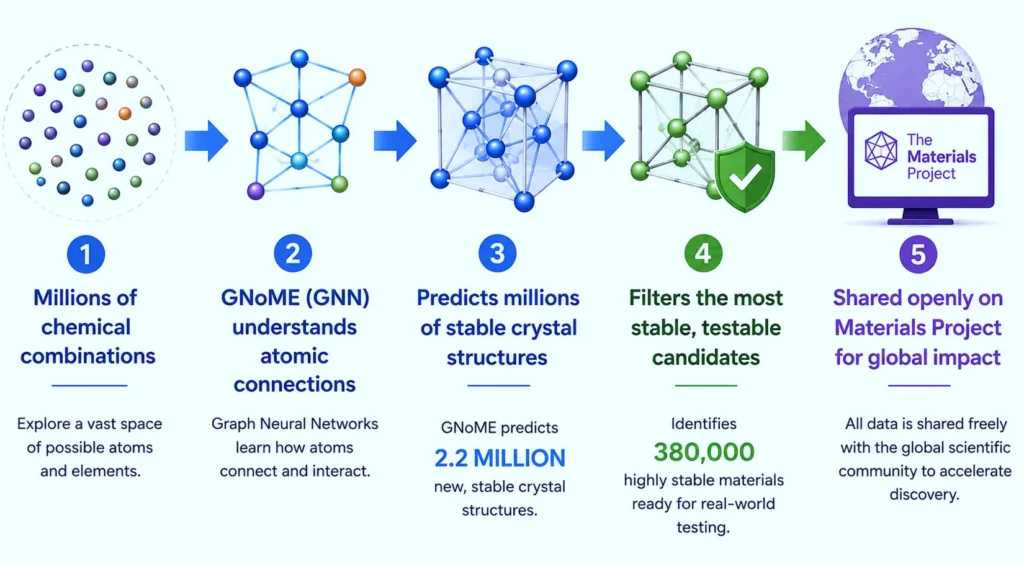
By analyzing millions of chemical combinations, GNoME achieved mind-boggling results:
- It predicted 2.2 million new, stable crystal structures -expanding humanity’s knowledge of stable materials by 10 times [4].
- It filtered out 380,000 highly stable materials that are perfect candidates for real-world testing [4].
- DeepMind shared all this data freely with the global scientific community by adding it to the Materials Project database [5].
In 2026, chemical engineers can search digital databases in seconds to find materials for better batteries, solar cells, and other technologies, then quickly create them using self-driving labs.
Related: Relation Between Van der Waals Constants and Critical Constants
Related: Clausius Clapeyron Equation Calculator, Derivation and Applications
Physics-Informed Neural Networks (PINNs): AI with Common Sense
AI can discover new molecules, but managing a chemical plant safely requires physical laws, not just data. Standard AI only knows numbers.
Without “common sense,” it might generate predictions that make mathematical sense but are physically impossible and dangerously wrong. To solve this, chemical engineers in 2026 rely on Physics-Informed Neural Networks (PINNs) [6].
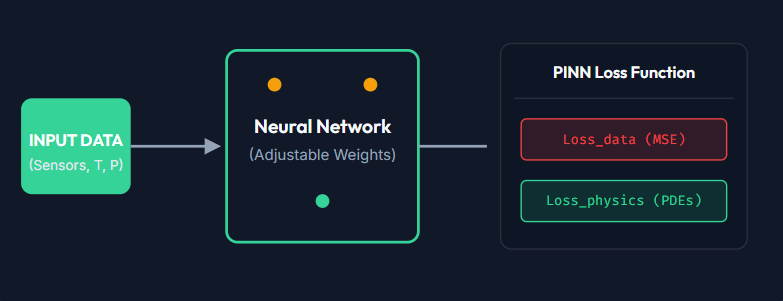
Instead of just looking at data, PINNs learn the laws of physics first. Embedding equations like the conservation of mass and energy directly into the AI’s learning system forces it to make physically realistic predictions.
Total Loss = Error in Data + Violation of Physics
If the AI makes a prediction that violates a physical law, it receives a heavy penalty. This guarantees that the AI’s predictions are always realistic, safe, and physically possible [7].
Today, PINNs are transforming chemical engineering by:
- Solving Plant-Model Mismatch: They combine real-time sensor data from physical pipes with physical laws to give engineers an exact, highly reliable picture of what is happening inside complex chemical reactors.
- Super-Fast Simulations: Traditional simulations of fluid flow (Computational Fluid Dynamics) used to take days on supercomputers. A PINN can solve these complex equations in milliseconds. This allows engineers to run instant “what-if” safety tests on the fly.
Related: Personal Carbon Footprint Calculator – Track your CO2 Emissions
Related: Why Chemical Engineers Are Switching to These Open-Source Tools in 2026
Industrial Digital Twins: Virtual Replica of Physical Factory
The ultimate integration of AI in chemical engineering happens at the factory scale. Today, chemical plants use Cognitive Digital Twins to manage their operations [8].
A digital twin acts as a real-time, virtual replica of a physical factory. Engineers use advanced platforms like NVIDIA Omniverse and ABB Genix to build them [8, 9].
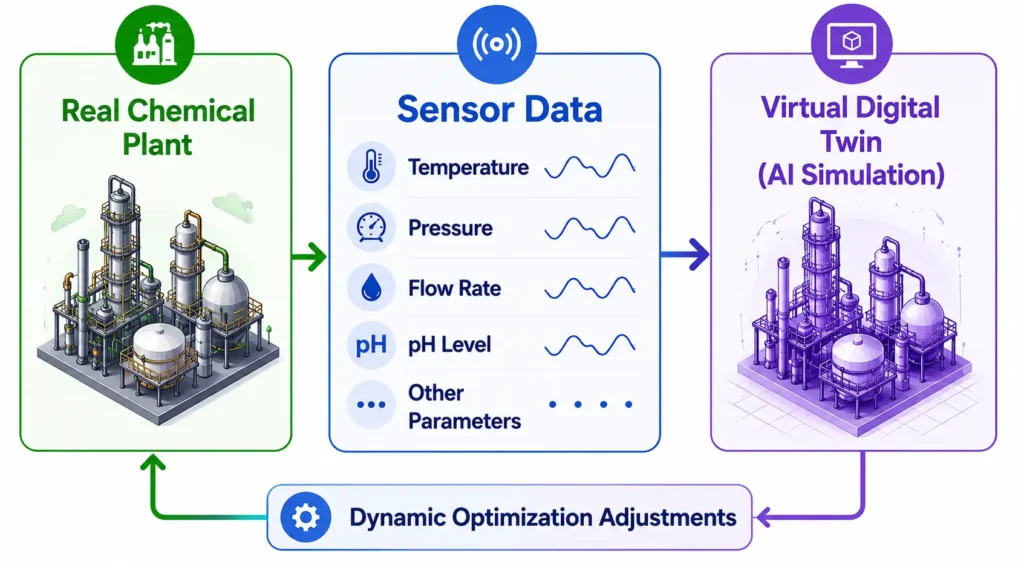
Because this virtual factory is connected to real-world sensors, it knows exactly what the real plant is doing at any given second. The AI brain inside the digital twin uses this data to make operations smarter, safer, and cleaner:
- “Golden Batch” Optimization: Dynamically adjusts temperature and pressure during batch processing, cutting energy waste by up to 12% [8].
- AI Copilots for Operators: Detects early equipment anomalies (e.g., micro-vibrations) and alerts operators with fix instructions to prevent breakdowns [8].
- Safe Testing: Engineers can safely test new ideas in the virtual plant without risking an accident or stopping production in the real factory.
Related: Kirchoff’s Law of Thermal Radiation, Wien’s Displacement Law
Related: Joule-Thomson Effect – Coefficient Calculation for CO2 and N2
The Changing Role of the Chemical Engineer
With AI handling laboratory experiments, molecular matching, and routine factory adjustments, Is the chemical engineer becoming obsolete?
Absolutely not. In fact, their job is becoming much more exciting.
Instead of spending hours manually calculating pressure drops, hand-tuning valves, or repeating tedious laboratory tests, the chemical engineer of 2026 acts as an AI System Orchestrator.
Their new responsibilities include:
- Setting Goals and Boundaries: Telling the AI systems what properties a new material needs to have, and setting the safety limits.
- Teaching Physics: Ensuring that AI models (PINNs) are loaded with the correct thermodynamic rules and chemical equations.
- Managing Safety and Ethics: Making the final safety calls, overseeing hazard analyses, and ensuring that AI-designed pathways are safe for humans and the environment.
AI is not replacing chemical engineers; it is giving them superpowers.
References
- Boiko, D. A., MacKnight, R., & Gomes, G. (2023). Autonomous chemical research with large language models. Nature, 624(7992), 570–578. https://doi.org/10.1038/s41586-023-06792-0
- Szymanski, N. J., Ramezanipour, F., Kononova, O., … & Ceder, G. (2023). An autonomous laboratory for the accelerated synthesis of novel materials. Nature, 624(7992), 585–591. https://doi.org/10.1038/s41586-023-06734-w
- Palgrave, R. G., & Schoop, L. M. (2024). Critique and verification of high-throughput autonomous solid-state synthesis. Chemistry World / Nature Discussion Correspondence, 11(2), 145–148.
- Merchant, A., Batzner, S., Schoenholz, S. S., … & Cubuk, E. D. (2023). Scaling deep learning for materials discovery. Nature, 624(7992), 579–584. https://doi.org/10.1038/s41586-023-06735-9
- Jain, A., Ong, S. P., Hautier, G., … & Persson, K. A. (2024). Integrating GNoME deep-learning structures into the Materials Project database. Scientific Data, 11(1), 32–39. https://deepmind.google/blog/millions-of-new-materials-discovered-with-deep-learning/
- Karniadakis, G. E., Kevrekidis, I. G., Lu, L., … & Wang, S. (2021). Physics-informed machine learning. Nature Reviews Physics, 3(6), 422–440. https://doi.org/10.1038/s42254-021-00314-5
- Raissi, M., Perdikaris, P., & Karniadakis, G. E. (2019). Physics-informed neural networks: A deep learning framework for solving forward and inverse problems involving nonlinear partial differential equations. Journal of Computational Physics, 378, 686–707. https://doi.org/10.1016/j.jcp.2018.10.045
- Datta, S. Digital Twin, Didymos, Meets Digital Cousin, Didymium. From Paradox to Paradigm or a Paradoxical Paradigm?. Preprints 2024, 2024111638. https://doi.org/10.20944/preprints202411.1638.v1
- Dimension Market Research. (2026). The Chemical Process Digital Twin Market: Global Forecast to 2035. Industrial Market Analysis Reports, Section 4.2.



Pingback: AI and Self-Driven Laboratories: The Chemical Engineering Revolution of 2026 – Help for Wandering Minds
Pingback: Google DeepMindのGNoMEが200万以上の新結晶構造を予測、AIと自律型ラボが化学工学を革新 | 技術情報発信(素材技術を未来へ)
Pingback: Google DeepMind’s GNoME Predicts Over 2 Million New Crystal Structures, Revolutionizing Chemical Engineering with AI and Autonomous Labs | Troy Technical