Table of Contents
In Process Engineering, water and steam the most important utilities. Whether you are designing industrial boilers, sizing steam pipelines, or optimizing heat exchangers, need of standard-compliant thermodynamic data is essential for reliable engineering calculations and process design.
ChemEnggCalc has developed the Online Steam Table Calculator fully complaint with the international industrial benchmark IAPWS-IF97. It allow users to calculate all critical properties of water and steam instantly, plot thermodynamic state points on phase diagrams, and generate custom saturation tables.
Related: Specific Heat Capacity Calculation for Water and Other Substances
Related: Water Density & Specific Weight Calculation – Variation with temperature and Pressure
Steam Table Calculator (IAPWS-IF97)
Our Steam Table Calculator based on IAPWS-IF97 Properties is an interactive solver designed for engineers to calculate the thermodynamic properties of water and steam instantly.
This calculator supports 8 coordinate input modes (such as P–T, P–h, and dryness fraction x) to calculate specific volume, enthalpy, entropy, internal energy, density, and speed of sound in real-time. Thermodynamic phase diagrams (T–s and P–h plots) and a customizable saturation grid table exporter to CSV is also provided
Also Read: Antoine Equation Calculator for Vapour Pressure versus Temperature Calculations
Also Read: Online Psychrometric Calculator for Chemical Engineers
What are IAPWS-IF97 Industrial Standard?
IAPWS-IF97 is the International Association for the Properties of Water and Steam Industrial Formulation 1997 is widely accepted global standard for calculating the thermodynamic and transport properties of water and steam.
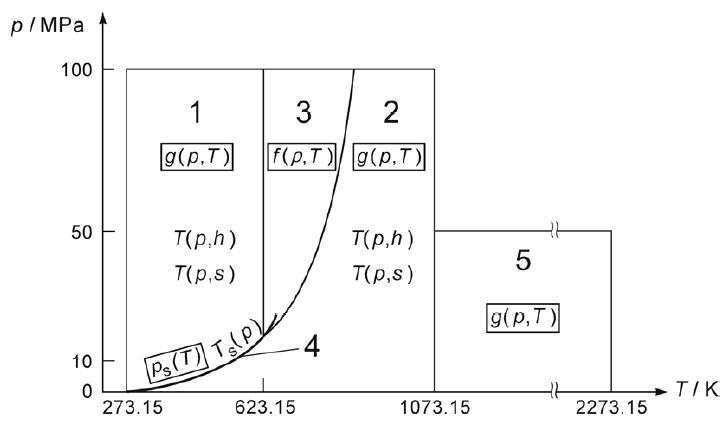
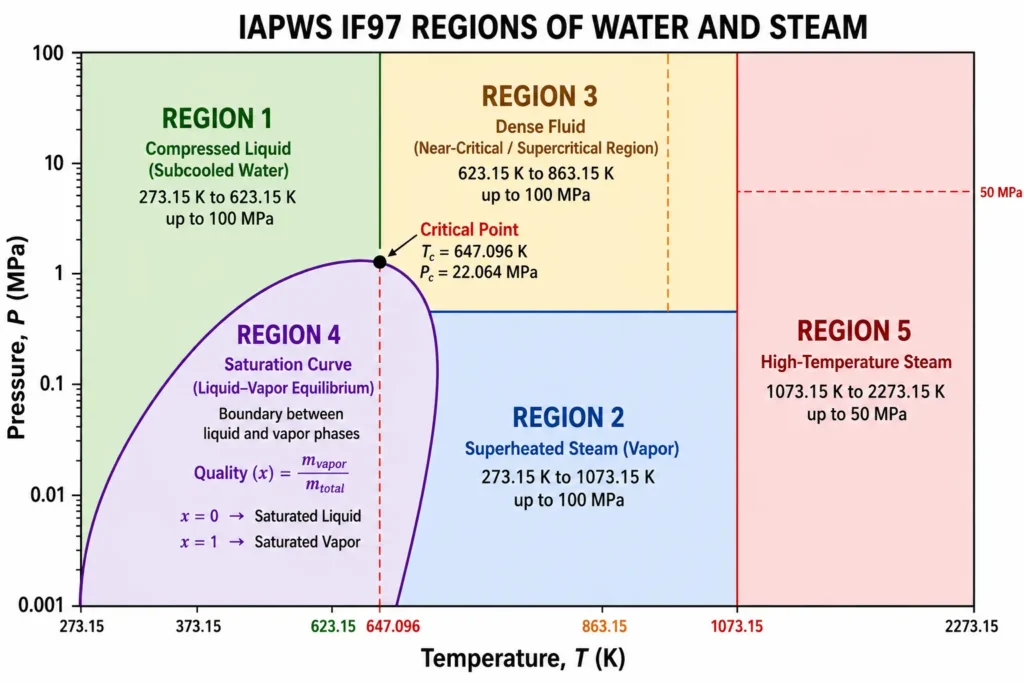
IAPWS-IF97 divides the thermodynamic state space of water substance into five distinct regions:
| Region | Physical State | Temperature Range | Pressure Range |
|---|---|---|---|
| Region 1 | Compressed (Subcooled) Liquid | 273.15 K to 623.15 K | From Psat(T) saturation pressure up to 100 MPa (1000 bar) |
| Region 2 | Superheated Steam / Vapor | 273.15 K to 1073.15 K | 0 MPa to 100 MPa (0 to 1000 bar) |
| Region 3 | Near-Critical & Supercritical Fluid | 623.15 K to 863.15 K | From P23(T) boundary line up to 100 MPa (1000 bar) |
| Region 4 | Two-Phase Saturation Curve (Liquid-Vapor Saturated Mixture) | 273.16 K to 647.096 K | 0.0006117 MPa to 22.064 MPa (0.006117 to 220.64 bar) |
| Region 5 | High-Temperature Steam | 1073.15 K to 2273.15 K | 0 MPa to 10 MPa (0 to 100 bar) |
Note: The Critical Point of Water is at 647.096 K & 22.064 MPa at which the distinction between liquid water and steam completely disappears.
According to IAPWS-IF97 regions are governed by a scientifically formulated fundamental equation:
- Regions 1, 2, and 5 are calculated using dimensionless equations for Gibbs free energy \(g(P, T)\). Taking analytical derivatives of Gibbs free energy yields exact, explicit formulas for volume, enthalpy, entropy, internal energy, and heat capacity (Reference link for equations provided here).
- Region 3 (near-critical) is represented by a dimensionless Helmholtz free energy equation \(\phi(\rho, T)\) due to the extreme fluctuations in density near the critical point. (reference link for equations provided here)
- Region 4 governs the liquid-vapor saturation dome boundary, the properties are solved using the thermodynamic lever rule (quality-weighted average) between Region 1 (saturated liquid) and Region 2 (saturated vapor) states.
Thermodynamic Properties Explanation
Our Steam Table Calculator evaluates eight fundamental thermodynamic and physical properties of water and steam: Pressure (P), Temperature (T), Specific Volume (v), Enthalpy (h), Entropy (s), Internal Energy (u), Heat Capacity (Cp), and Speed of Sound.
Specific Volume & Density
Specific Volume \(v\) is the volume occupied by one kilogram of fluid (m3/kg).
Density \((\rho = 1/v)\) is the mass per unit volume \(kg/m^3\).
Sizing pipelines and vessels requires accurate density calculations to account for momentum, velocities, and pressure drops.
Specific Enthalpy
Enthalpy represents the total heat content of the system \(kJ/kg\). It is the sum of internal energy and flow work:
$$h = u + P \cdot v$$
Specific Entropy
Entropy \(kJ/(kg\cdot K)\) represents the measure of system disorder or thermal energy unavailable to do useful work. In an ideal, isentropic expansion (such as a perfect turbine or compressor), entropy remains constant:
$$s_{in} = s_{out}$$
Specific Internal Energy
Internal energy represents the microscopic kinetic and potential energy of the molecules \(kJ/kg\). It is calculated using:
$$u = h – P \cdot v$$
Vapor Quality
Vapor Quality also known as steam dryness fraction, quality represents the mass fraction of vapor in a saturated liquid-vapor mixture:
\[x = \frac{m_{vapor}}{m_{total}}\]
- \(x = 0\) corresponds to pure saturated liquid (on the bubble-point line).
- \(x = 1\) corresponds to pure saturated vapor (on the dew-point line).
- \(0 < x < 1\) represents a two-phase wet steam mixture, solved via the lever rule: \(h = (1-x)h_l + x \cdot h_g\)
Isobaric Heat Capacity (Cp)
Heat capacity is the heat required to raise the temperature of 1 Kgof fluid by 1 K at constant pressure (\(kJ/(kg\cdot K)\)).
Speed of Sound
The velocity (m/s) at which acoustic pressure waves propagate through the fluid. It is essential for analyzing compressible flow, sonic choking in valves, and designing steam ejectors or high-velocity relief lines.
Related: Clausius Clapeyron Equation Calculator, Derivation and Applications
Also Read: Van der Waals Equation Calculator and PV Isotherm for Real Gases
This Online Steam Table Calculator is verified with a 100% exact match with the official IAPWS-IF97 standard benchmarks. Bookmark this page, embed the tool in your workflows, and utilize the built-in CSV exporters to accelerate your thermodynamics calculations!
Above calculator is also live on our github pages – https://chemenggcalc.github.io/steam-table-calculator/
Resources
- IAPWS-IF97 Standard Release– Available at: https://iapws.org/documents/release/IF97-Rev (Revised in 2007, 2014, and 2018 for editorial updates).
- Saturation Boundary Equation – IAPWS, Revised Advisory Note No. 3: Thermodynamic Properties on the Saturation Line*, IAPWS Secretariat, September 2018.
- IAPWS, Supplementary Release on Backward Equations for Region 3 of the Industrial Formulation IAPWS-IF97, IAPWS Secretariat, September 2005.
- Critical Constants & Triple Point Reference – IAPWS, Release on the Pressure along the Melting and Sublimation Curves of Ordinary Water Substance, September 2011.
Disclaimer: The Solver provided here is for educational purposes. While efforts ensure accuracy, results may not always reflect real-world scenarios. Verify results with other sources and consult professionals for critical applications. Contact us for any suggestions or corrections.