Table of Contents
In Chemical Engineering, vessels like reactors, storage tanks, and mixing tanks are used to handle fluids, gases, or solids and it is required to know thesurface area, volume & blank size of the vessel heads to ensure accurate design and safety.
ChemEnggCalc has developed the ready-to-use Vessel Head Calculator which is an engineering tool used primarily in the design, fabrication, and maintenance of pressure vessels and storage tanks across the chemical, oil and gas, and food processing industries.
Also Read: Vessel Volume Calculator for Ellipsoidal, Hemispherical, Horispherical & Flat Head Type
Surface Area, Volume, Blank Size & Weight Calculator for various Vessel Heads
This advance ChemEnggCalc Vessel Head Calculator helps user to simplify the complex complex geometry calculations required for industrial design and fabrication. It provides accurate results for Surface Area, Volume, and Estimated Weight across various ASME-standard head types, including Ellipsoidal, Hemispherical, and Torispherical shapes.
Our tool also offers high-value professional features such as Blank Diameter estimation for fabricators, Paint and Coating requirements based on coverage rates, and an Advanced Mode for exact mathematical integration of custom knuckle and crown radii.
Related: Area of Cross-Section Calculator for Hollow Sections, Beams & Shapes
Related: Friction Factor Calculator Moody’s Diagram for Smooth and Rough Pipes
Vessel Head Calculation for Surface Area, Volume, Blank Size & Weight
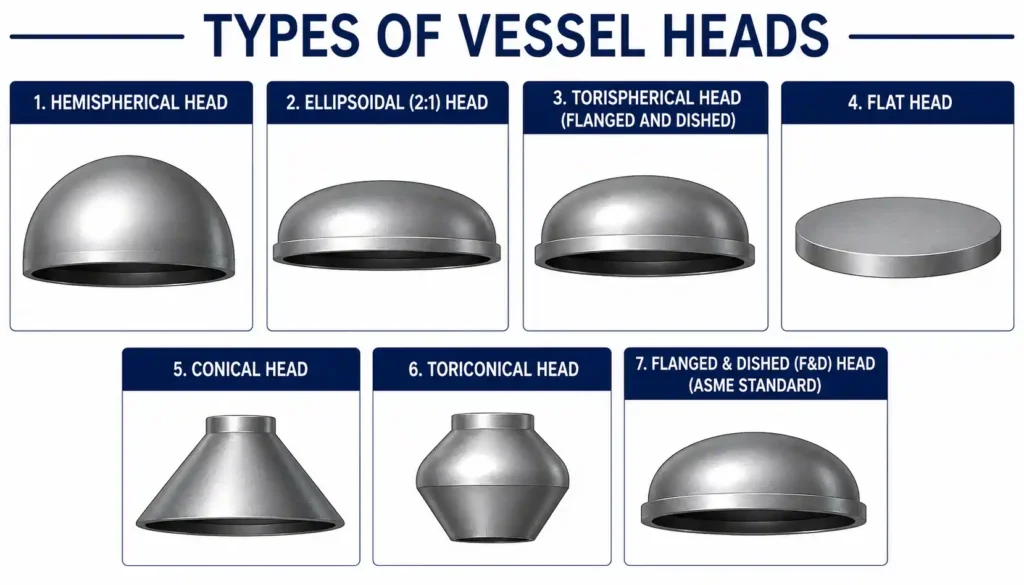
Vessel Heads (also called end caps) are the curved or flat ends of pressure vessels and storage tanks. These heads must withstand internal pressure, which is calculated by balancing between material thickness, volume requirements and manufacturing costs.
Here, we’ve provided the different types of vessel heads commonly used in chemical engineering design.
Related: Head Loss or Pressure Loss Calculator using Darcy-Weisbach Equation
Related: Centrifugal Pump Sizing Calculation – TDH, NPSHa vs Flow Rate curve & Power Required
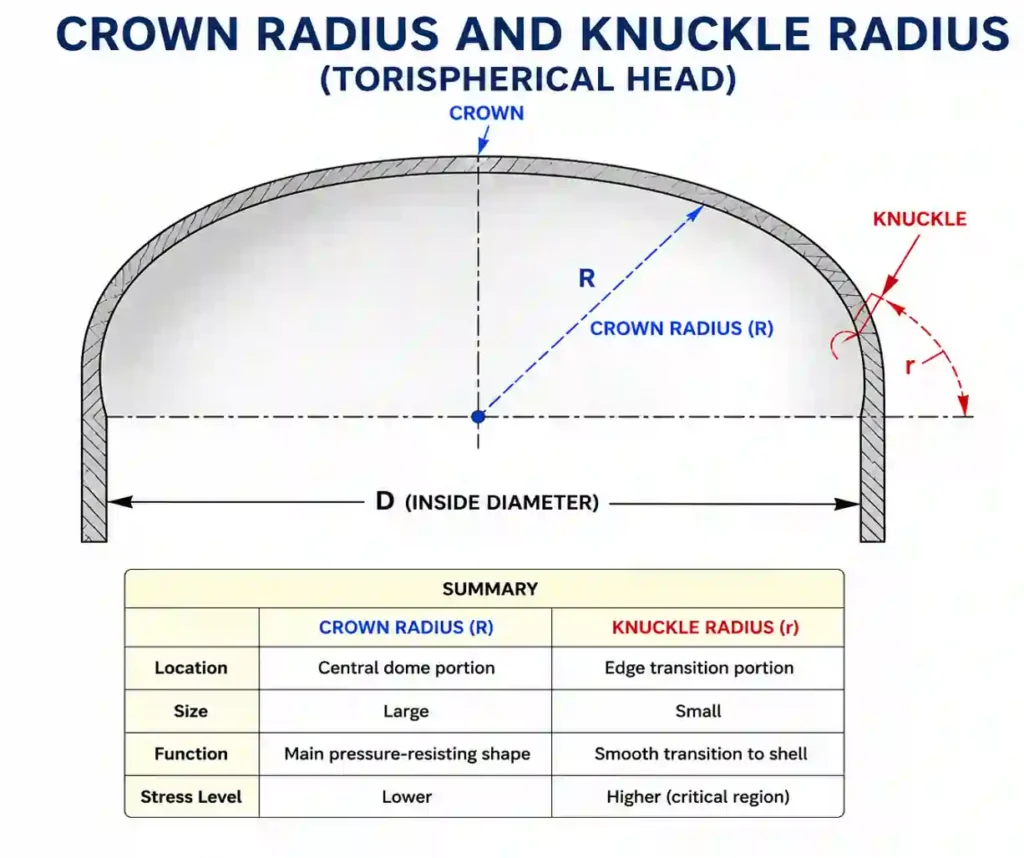
Knucle Radius & Crown Radius
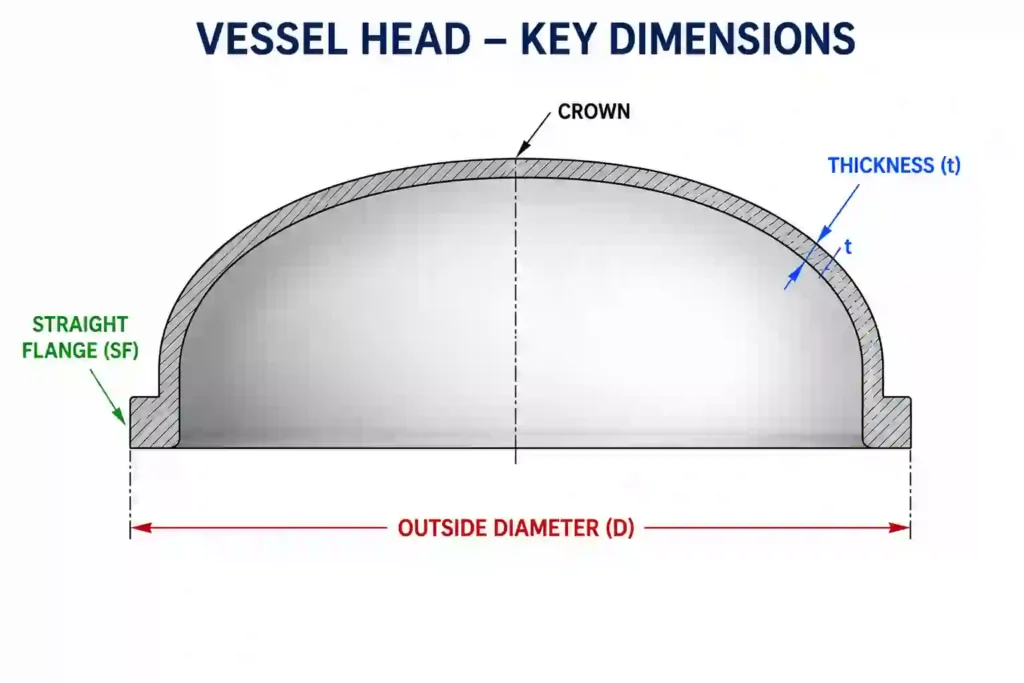
The knuckle Radius (Kr) is the sharp, tight curve located at the outer edge of the head that connects the crown to the straight flange or shell.
The crown radius (Rc )is the large, shallow curved section located at the center (apex) of the vessel head. It represents the curve of the very top of the head into a giant, complete circle, the crown radius is the radius of that circle.
To comply with ASME Section VIII codes, The inside knuckle radius of a torispherical head shall be not less than 6% of the outside diameter of the skirt of the head, but in no case less than three times the knuckle thickness.
Related: Area of Cross-Section Calculator for Hollow Sections, Beams & Shapes
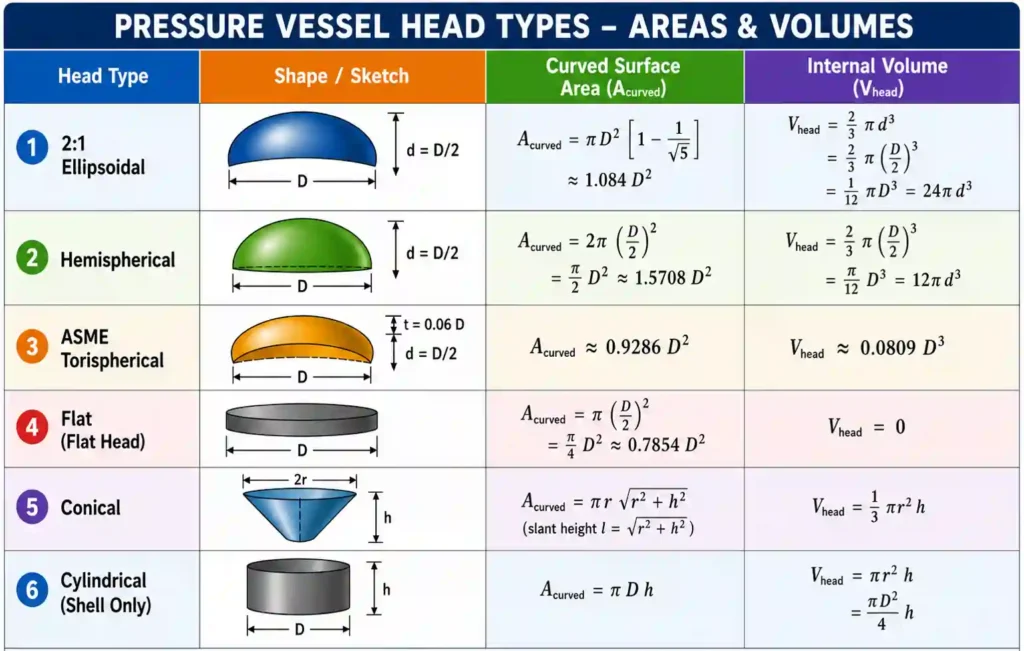
Surface Area for Vessel Heads
The total surface area (Atotal) of a pressure vessel head is calculated the addition of curved portion of the dish (Acurved) and the straight cylindrical section at its base (straight flange).
Atotal = Acurved + Aflange
The surface area of the straight flange is calculated as a cylinder: Aflange = π x D x SF
The industry-standard formulas used to determine the outside curved surface area () for the most common ASME-standard head types are given in the table below.
Weight of Vessel Heads
The weight of a vessel head is calculated by multiplying the total surface area of the head (including both the curved dish and the straight flange) by the material’s wall thickness and its volumetric density.
Weight = (Acurved + Aflange) x t x ρ
Blank Size of Vessel Head
The blank size (or blank diameter, Dblank) of a vessel head is the diameter of flat circular metal plate required to form a dished pressure vessel head.
The blank diameter is very useful in manufacturing because it gives fabricators the exact size of the flat metal sheet needed to form a vessel head before pressing, spinning, or deep drawing begins.
Below is the table for calculating the Blank Size (Dblank) of various pressure vessel heads.
| Head Type | Blank Diameter Formula (Dblank) |
| Flat Head | D + (2 * SF) |
| ASME Torispherical | (1.09 * D) + (2 * SF) |
| 2:1 Ellipsoidal | (1.16 * D) + (2 * SF) |
| Hemispherical | ((π * D) / 2) + (2 * SF) |
| Conical | (2 * sqrt((D/2)^2 + h^2)) + 2 SF |
For the given values of knuckle radius and crown radius, the blank size for advanced geometries can be calculated as follows:
$$D_{blank} = D + \frac{D}{42} + 2 \times SF + \frac{2}{3}K_r + t$$
Paint & Coating Estimation for Vessel Heads
Pressure vessels often handle corrosive liquids and operate under extreme conditions. To protect the underlying steel from rust and chemical attack, specialized protective coatings such as zinc-rich primers, or glass linings are applied to both the internal and external surfaces.
Industrial coatings are expensive, so accurate calculation is essential. Overestimating can lead to costly material waste. Our calculator helps determine the final liquid paint volume required for coating the vessel surfaces.
The paint volume is calculated as :
Theoretical Liters = Total Area (in m2) / Paint Coverage (in m2/L)\
However, in real-world applications, coating losses due to overspray and material wastage are also considered, so a higher paint volume is usually taken into account.
Actual Liters Needed = Theoretical Liters * (1 + (Wastage_Percentage / 100))
Resources
- ASME Boiler and Pressure Vessel Code (BPVC) Section VIII, Division 1
- Industrial Monitor Direct Technical Knowledgebase
- CIS Inspector’s Guide to Pressure Vessel Design Rules
- AccessEngineering Library – Perry’s Chemical Engineers’ Handbook digital edition.
Disclaimer: The Solver provided here is for educational purposes. While efforts ensure accuracy, results may not always reflect real-world scenarios. Verify results with other sources and consult professionals for critical applications. Contact us for any suggestions or corrections.